That’s a fantastic topic! You’re hitting on something crucial for small and medium-sized enterprises (SMEs).
Here is the rewritten blog article, simplifying the complex ideas of CRM and ERP integration into friendly, everyday language.
🚀 Level Up Your Business: Why CRM and ERP Are Your SME’s New Best Friends
Hey there! 👋 Elizabeth here, and let me tell you, when I first started my own digital endeavors, the paperwork, the spreadsheets, the sheer amount of stuff to keep track of was enough to make my head spin. Every small and medium-sized business (SME) owner knows this struggle. You’re wearing ten hats, and keeping your customer relationships and business operations running smoothly can feel like juggling chainsaws.
That’s where the power duo of CRM (Customer Relationship Management) and ERP (Enterprise Resource Planning) comes in. Forget confusing tech jargon—think of these systems as the ultimate digital assistants designed to help your business run like a well-oiled machine, letting you focus on what you love most: serving your customers and growing your company!
What Even Are CRM and ERP? (A Simple Analogy)
Before we dive into how they work together, let’s break down what each one does in simple terms.
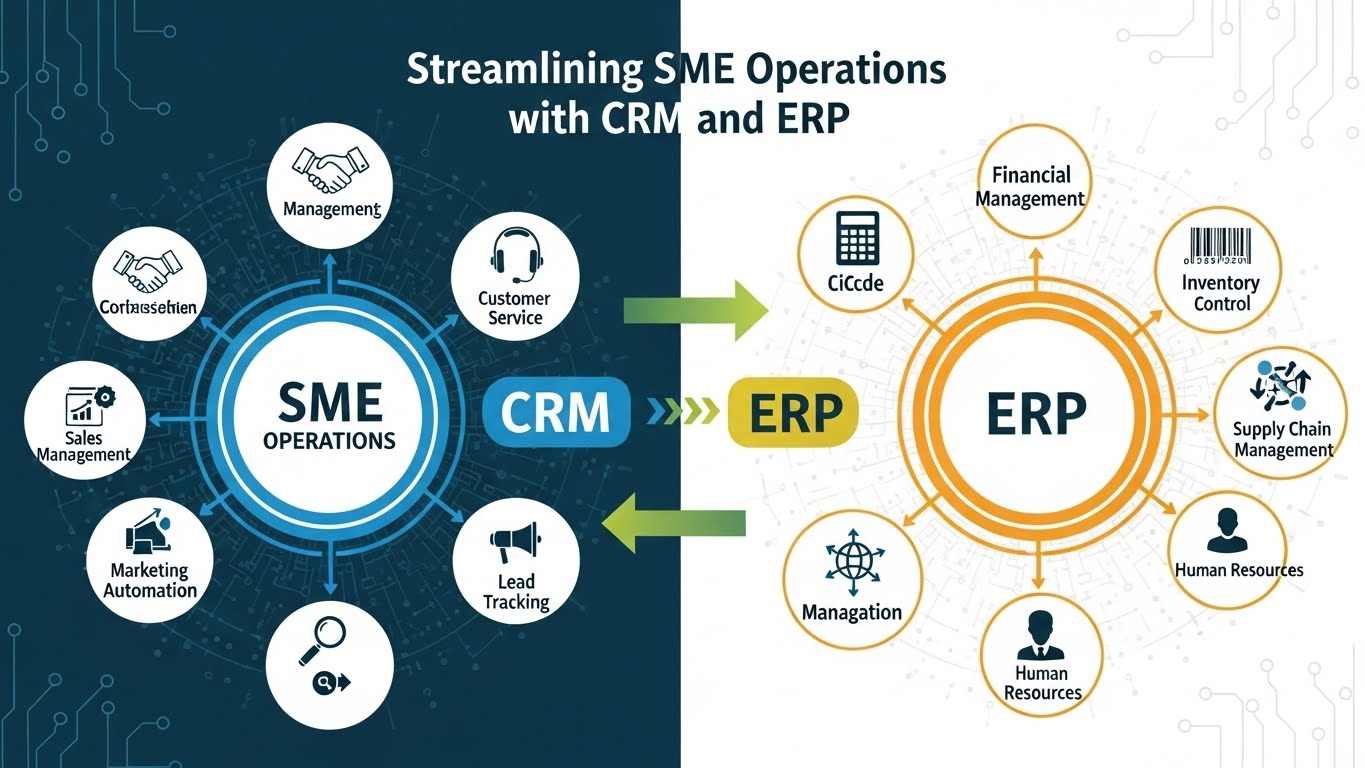
🤝 CRM: Your Customer-Centric Superpower
Imagine your best friend who remembers everyone’s birthday, favorite coffee order, and exactly what they talked about last week. That’s your CRM system!
- What it tracks: Everything related to your customers—sales leads, purchase history, support tickets, email communication, and even their browsing habits on your site.
- The Goal: To help you nurture and improve customer loyalty. It makes sure your sales, marketing, and support teams are all on the same page, giving your customers an amazing experience.
- Keywords: Customer engagement, sales pipeline, lead nurturing, personalized marketing.
⚙️ ERP: Your Internal Business Brain
Now, imagine the organized control tower at an airport, managing all the logistics—fuel, schedules, baggage, and staff. That’s your ERP system!
- What it tracks: Everything related to the back-office operations—inventory, purchasing, manufacturing, accounting, payroll, and supply chain management.
- The Goal: To ensure operational efficiency and financial accuracy. It makes sure you have the right stuff (inventory) at the right time and for the right price.
- Keywords: Inventory management, financial reporting, resource planning, supply chain visibility.
The Magic of Combining Them: Why Integration Matters ✨
A lot of smaller businesses start with just a CRM to handle sales or just accounting software (a simple ERP component). But the real game-changer comes when you get these two systems to talk to each other.
Think of it this way:
- Without integration, your sales team (in the CRM) promises a customer a product, but they have no idea if the warehouse (managed by the ERP) actually has it in stock. Chaos ensues!
- With integration, the CRM instantly checks the ERP for real-time inventory levels. The sales rep can give the customer an accurate delivery date and price, right there on the spot. Seamless customer service!
This merging of front-office (customer-facing) and back-office (internal) systems is how you achieve true business process optimization.
💡 Real-Life Benefits for Your Growing SME
When your CRM and ERP are working together, you see immediate, tangible improvements across your company.
1. Faster, Happier Sales Cycles
- The Problem: Sales reps waste time manually checking with the accounting team about a client’s credit history or whether an item is in stock.
- The Solution: The CRM pulls data directly from the ERP. Your sales team can generate a quote that includes the most current pricing, check inventory availability, and see a customer’s payment history all from one screen. This leads to faster deals and a better experience for the customer.
2. Spot-On Financial Forecasting
- The Problem: The accounting team’s forecast is based on old data, while the sales team is sitting on a huge pipeline of potential deals that haven’t been factored in yet.
- The Solution: Integrated systems give you a single source of truth. Sales projections from the CRM are automatically fed into the ERP’s financial modules. This provides the owners and managers with an incredibly accurate view of future revenue and resource needs.
3. Stellar Customer Service (Even When Things Go Wrong)
- My Personal Insight: Early on, a customer called upset about a late shipment. I was looking in one system and the tracking info was in another! Now, with integration, a support rep can instantly see:
- What the customer bought (from CRM).
- Their order status and tracking info (from ERP).
- Their last invoice and payment status (from ERP).
- Any previous support tickets (from CRM).
4. Streamlined Inventory and Order Management
- When a sale is finalized in the CRM, it automatically triggers an order fulfillment request in the ERP. No one has to manually type the order into the warehouse system. This is a huge win for data accuracy and saves loads of time. You’ll say goodbye to the frustration of stockouts or dead stock!
🛠️ Practical Tips for Getting Started with Integration
Don’t feel overwhelmed! Moving to an integrated system is a journey, not a sprint. Here are a few starter tips to make the transition smooth.
- Start Small: Don’t try to integrate every single feature on Day 1. Focus on the most important link first, like automatically syncing new customer data and sales orders. This ensures your foundation is solid.
- Focus on Training: This is often overlooked. Your teams need to understand the why and how. Invest time in training your sales, support, and accounting teams on the new workflow so everyone feels confident and adopts the system fully.
- Choose Compatible Systems: When you’re shopping for software, always ask about integration capabilities. The best setup is often a unified platform that offers both CRM and ERP features natively, or systems that are known to «play nice» with each other. This is crucial for data synchronization.
- Review Your Processes: Technology alone can’t fix a broken process. Before you implement, use this opportunity to review how you handle sales, orders, and service. Documenting your processes first will make the system setup much easier.
🎉 Conclusion: Your Future is Integrated
I know technology can feel intimidating, especially for small business owners. But embracing an integrated CRM and ERP solution isn’t about being a huge corporation; it’s about giving your SME the structural foundation it needs to compete, scale, and thrive without sacrificing your sanity.
By streamlining operations, gaining better supply chain visibility, and ensuring every customer interaction is informed and consistent, you’re not just automating tasks—you’re building a smarter, stronger, and more profitable business.
You’ve got this! Taking this step is the hallmark of a truly committed business owner.
➡️ What’s Your Next Step?
Ready to stop the spreadsheet shuffle? I recommend you start by listing the top three pain points in your current operations (e.g., «slow order processing,» «inaccurate inventory,» «missed follow-ups»). Use that list to research integrated software solutions and schedule a demo!